

I speak to business owners every single day.
Do you know the number one complaint I hear? It isn’t about traffic. It isn’t even about the product.
It’s about capacity.
You want to run 24/7 customer support, but you can’t afford the headcount. You want to prospect thousands of leads, but your sales team is bogged down with admin.
You are stuck trading time for money. And that is a losing game.
But the game is about to change.
In their latest strategic update, HubSpot Ventures has made it clear that they are prioritising deeper innovation over minor refinements to email templates and dashboards.
They are going all-in on AI Agents.
If you think this is just another buzzword, you are missing the biggest shift in business automation we have seen in a decade. This isn’t about AI writing a blog post for you. It is about AI running entire departments for you.
Here is what HubSpot’s move means for your business, and more importantly, how you can use it to fix your margins and scale faster than you thought possible.
The Shift: From Copilots to Autonomous Agents
Most of you are already using AI. You might use ChatGPT to draft an email or Midjourney to create an image.
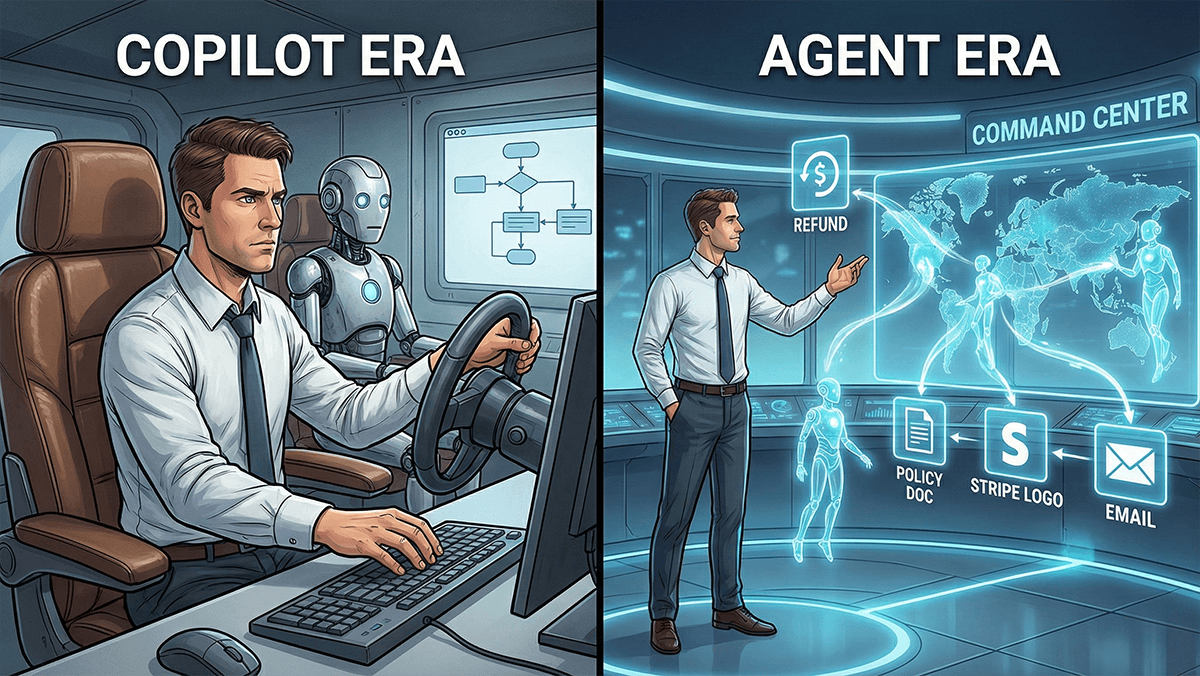
That is what we call a “Copilot” model. You are the pilot; the AI sits next to you. It waits for your command. It helps you fly, but if you take your hands off the wheel, the plane crashes.
HubSpot is investing in the next phase: Agents.
An AI Agent doesn’t wait for a prompt. It has a goal. It has tools. And it has the autonomy to figure out how to achieve that goal.
Think about the difference:
- Copilot: You ask a chatbot, “Write a response to this angry customer.” You read it, edit it, and hit send.
- Agent: You tell the software, “Resolve all refund requests under $50 according to our policy.” The agent monitors the inbox, reads the tickets, checks your policy, processes the refund in Stripe, and emails the customer. You never touch it.
HubSpot Ventures is pouring capital into this technology because it sees the writing on the wall. The future of the “Smart CRM” isn’t a database you manage. It is a workforce you direct.
Why This Matters for Your P&L
Why should you care about where HubSpot puts its venture capital?
Because where the money goes, the features follow. And these features directly attack your biggest cost centres.
1. Crushing Your Service Costs
Customer service is expensive. You either pay for a massive team to cover 24/7 shifts, or you accept that your customers will wait 12 hours for a reply.
Neither option is great.
Autonomous agents change the math. If an agent can handle complex workflows—like troubleshooting a technical issue, updating billing details, or scheduling an appointment—you don’t need a human in the loop for 80% of your tickets.
This doesn’t mean you fire your support team. It means your human team focuses only on the high-value, complex issues that require empathy and judgment.
The result? You increase your operational capacity to 24/7 without adding a single dollar to your payroll. That massively improves your gross margin.

2. Automated Sales Prospecting
Sales development representatives (SDRs) have a tough job. They spend hours researching leads, finding emails, and sending generic outreach.
It is high-effort, low-yield.
HubSpot’s focus on agents suggests a future in which your CRM handles prospecting. An agent could scour the web for companies matching your ideal customer profile, identify the decision-maker, research their recent news, and draft a hyper-personalised outreach email.
Your sales team wakes up to a calendar full of booked meetings, rather than a list of cold leads they need to call.
This shortens your sales cycle and drastically lowers your Customer Acquisition Cost (CAC).
How You Can Optimise Your Business for the Agent Era
You might be thinking, “That sounds great, but it’s not here yet.”
It is a simple reality that the companies achieving the most significant growth are those that lay their groundwork well in advance.
AI Agents are not magic. They run on data. If your data is messy, your agents will be stupid. If your processes are unclear, your agents will be chaotic.
If you want to capitalise on this wave of automation to improve your revenue and margins, here is what you need to do right now.

Step 1: Clean Your Data (No, Really)
I say this all the time, but now it is critical.
AI agents need context to make decisions. If your HubSpot CRM is full of duplicates, missing fields, or outdated contact information, it will not function properly. It will email the wrong person or fail to find the account history.
Action Item: Audit your CRM data. Define your “single source of truth.” If your data is scattered across spreadsheets and sticky notes, bring it into HubSpot. The cleaner your data, the brighter your agents will be.
Step 2: Map Your Workflows
An autonomous agent needs rules. It needs to know “If X happens, do Y.”
Most businesses operate on tribal knowledge. Bob from accounting knows how to handle that specific invoice issue, but it isn’t written down anywhere.
You need to document your processes.
- How do you qualify a lead?
- What are the exact steps to onboard a new client?
- What is the protocol for a service outage?
Action Item: Start mapping your core workflows. Identify the repetitive, logic-based tasks that consume your team’s time. These are the first jobs you will hand off to an agent.
Step 3: Shift Your Mindset to “Orchestration”
In the past, a manager’s job was to supervise people. In the near future, your job will be to orchestrate agents.
You need to stop thinking about “hiring more hands” and start thinking about “deploying more compute.”
While reviewing your budget, consider whether a new junior hire is truly necessary, or if you can develop your infrastructure so an AI agent manages the role at 10% of the cost.
This mindset shift is how you protect your margins. Instead of your costs growing linearly with your revenue, you break the link between them. You can scale your output without scaling your overhead.
The Risks You Need to Watch
Of course, this isn’t without risk.
Automated agents can make mistakes. We have all seen chatbots hallucinate or give wrong information.
When you hand over the keys to an autonomous agent, you need guardrails.
HubSpot is investing heavily in “accountability” and “oversight” for these agents. They know that businesses won’t trust a black box.
For you, this means implementing rigorous testing. Don’t just turn an agent loose on your entire database. Test it on a small segment. Monitor the results. Refine the instructions.
Trust is hard to earn and easy to lose. Use these tools to improve reliability, not just speed.
Conclusion
The investment from HubSpot Ventures is a signal. It is a flare gun going off in the night.
The era of manual data entry and repetitive admin work is ending. The era of the autonomous enterprise is beginning.
You have two choices.
You can ignore it. You can keep running your business the way you always have, hiring more people to do repetitive tasks, and watching your margins get squeezed by competitors who can operate faster and cheaper than you.
Or, you can prepare. You can organise your data, map your processes, and get ready to deploy a digital workforce that works 24/7, never sleeps, and costs a fraction of a human team.
The technology is coming. The businesses that are ready for it will see a significant increase in efficiency and profitability.